Page Content Switzerland promotes an integrated disaster risk management (IDRM) approach. IDRM is a central element in many of the risk-oriented planning guidelines used and applied by several federal offices such as the Federal Office for Civil Protection (FOCP), the Federal Office for the Environment (FOEN) and the Swiss Agency for Development and Cooperation (SDC). It is also applied by cantons and organisations (e.g. Swiss National Platform for Natural Hazards PLANAT). Risk: It is a measure used to evaluate a hazard, and factors in the frequency or probability of an undesirable event, as well as the extent of the damage that it would cause. Disaster risk: it includes risk of disaster to occur triggered by a natural hazard.Disaster Risk Management: It is defined as a systematic process for the comprehensive treatment of risks. The elements of risk management are described in the following figure: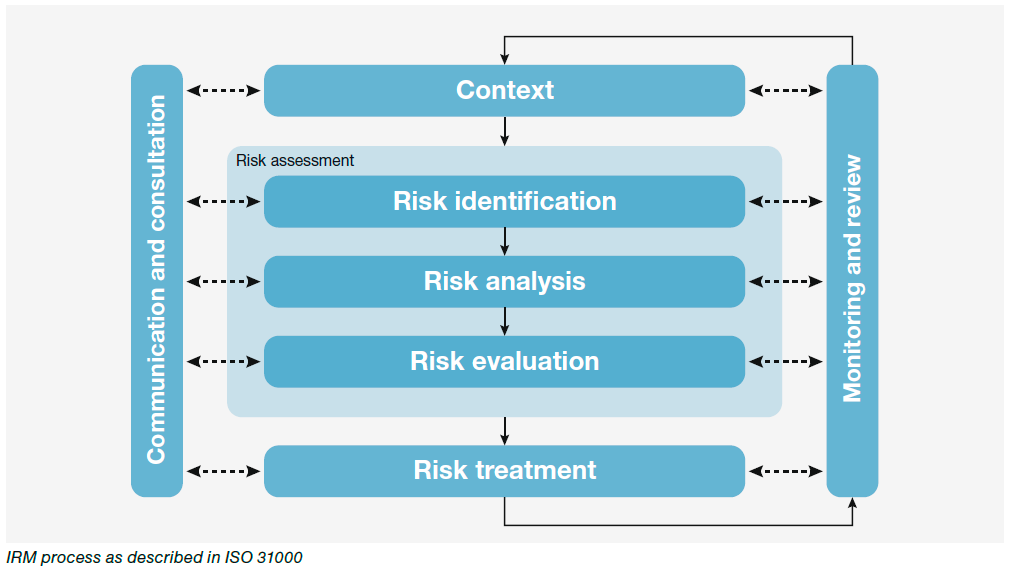
Integrated Disaster Risk Management: Frequently, integrated risk management is represented by the cycle of measures that is depicted in the following diagram. 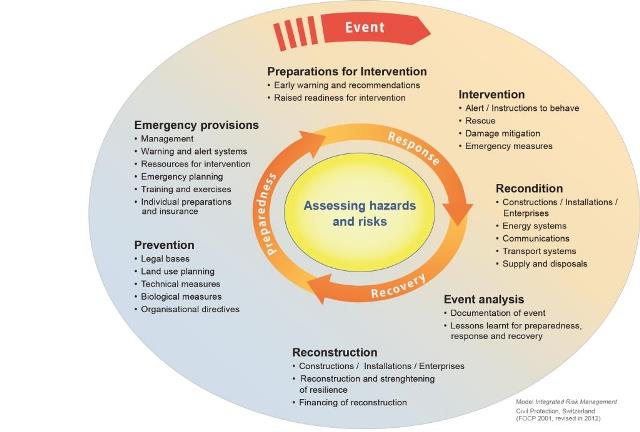
The broad range of measures in the IDRM cycle has to be continuously reviewed to keep risks at an acceptable level. The cycle covers measures for prevention and preparedness, e.g. the seismic resistant construction of buildings or training of rescue teams. Response aims at limiting the extent of losses. After an event, both reconstruction measures, e.g. repair of vital facilities such as schools and hospitals, and rehabilitation measures, e.g. restoring livelihoods and supporting the functioning of schools or health centres, have to be taken. They should be based on event analyses and lessons learnt in order to avoid repeating failures from the past and to reduce possible future losses. Recovery efforts must avoid creating new risks and exacerbating existing ones ('build back better'). Successful integrated disaster risk management considers prevention / mitigation, preparedness, response and recovery as complementary mechanisms that need to be combined in an appropriate way and involve all actors and affected people.The fundamental objective of integrated risk management (IRM) is to ensure that risks to people and their livelihoods are kept as low as possible or within acceptable bounds. Time and again, this raises the question of "how safe is safe enough?" – in other words, how much should be spent on measures to improve security for people and their livelihoods, and what should be accepted if an event were to occur? Risk management is described as integrated risk management when four conditions are fulfilled:All of the hazards that are relevant to a society, and their related risks, are considered in the sense of an integrated hazard analysis.Sophisticated damage indicators as well as ecological, economic and social sustainability criteria are applied to produce an integrated evaluation and assessment of the hazards and their related risks, as well as of the impact of planned measures to reduce those risks. In monitoring and reviewing the hazards and their related risks, the full spectrum of available preparedness, response and recovery measures are considered, in the sense of integrated action planning. In the interest of an integrated participation, all relevant decision-makers, specialists and those who are affected are involved in the IRM process.
Integrated risk management (IRM) is a proven general methodology for treating hazards and their related risks with appropriate actions in a systematic and comprehensive way that complies with the principles of sustainability. At the same time, IRM also expresses a certain mindset to addressing the challenges posed by the wide range of hazards and their risks: comprehensive, transparent, and comprehensible, as well as in cooperation with all relevant decision-makers, others concerned, and those who are affected. However, integrated risk management also implies a pragmatic flexibility to adapt to changing circumstances, rather than dogmatically applying its elements and principles.Focus on reducing vulnerabilitiesTo contribute to making communities more resilient, prevailing risks have to be prevented, reduced or transferred to another party. DRR measures aim at avoiding or reducing exposure, reducing vulnerability or reducing the hazard; often they tackle all aspects at the same time.In many cases, risks grow and new risks arise more as a result of population growth or (urban) expansion of settlements into hazard-prone areas than to the changing hazard situation. Therefore, it is more effective to focus on the reduction of vulnerabilities (for example with risk-based land-use planning) than on hazard prevention with technical protection measures, which are often not feasible and incur high costs. DRR is a governance issuePoverty reduction, sustainable development and DRR are mutually supportive objectives. They are strongly influenced by the way public affairs are managed and authority is exercised. The SDC's DRR programmes therefore also support countries in making further progress in improving the quality of governance processes in regard to IDRM in accordance with the principles of effectiveness and efficiency, transparency and accountability, participation, equality and non-discrimination, and rule of law at all state levels. "… the benefits of prevention are not tangible; they are the disasters that did NOT happen." (Kofi Annan, 1999)Although increased safety, secured livelihoods and protected assets are often only visible and recognised as such after an event, DRR measures provide additional benefits. They can improve access to services and offer opportunities to improve the livelihoods of individuals and communities over the long term. For example, agricultural techniques that aim at reducing slope erosion may also contribute to higher yields. Disaster risk management is a cost-effective investment in sustainable developmentIntegrated disaster risk management is a cost-effective investment in sustainable development. There is growing evidence of the economic benefits of specific programmes aimed at reducing disaster risk. The evaluation of the effectiveness of SDC DRR programmes [1] shows that every Swiss franc spent on risk reduction yields a return of four to seven Swiss francs in non-occurring disaster losses.Recovery phase, a window of opportunity for changeTo be successful, DRR measures have to be carried out well before a disaster hits. It is necessary to move the focus from merely responding to disaster to pursuing pre-disaster prevention and preparedness activities. Unfortunately, it often takes a major disaster to mobilise the necessary political commitment and adequate resources. In such cases, the recovery phase after a disaster can provide a crucial window of opportunity for enduring change (e.g. in environmental management, access to land, water resources or finance, and in power structures) and building resilience to future risks.Watch the video on Integrated Disaster Risk Management in English, Spanish, French
For further reading please refer to the Intergated Risk Managment brochures which has been produced by the Federal Office for Civil Protection (FOCP) - soon available in Spanish as well:[1] SDC, 2011: Disaster Risk Reduction in International Cooperation: Switzerland's Contribution to the Protection of Lives and Livelihoods. |
|